

The traditionalist mentality that thrived in the 2010s, largely unchecked by institutional guardrails or scholarly expertise, may have seemed conducive to denominational loyalty, safely compliant to church leadership. It would take the polarizing political conflicts of the 2020s, particularly the election of 2024 and the assassination of conservative activist Charlie Kirk in 2025 to reveal how deeply and widely the populist apocalyptic traditionalism in Adventism had become intertwined with the populist antiliberal reaction that powered Donald Trump’s MAGA following and thus bring to light fissures of unprecedented depth in the American church.
The General Conference’s strong support for COVID-19 vaccinations stirred an uprising that revealed points of contact between right-wing Adventism and the nationwide resistance to vaccine mandates and other COVID regulations as oppressive restrictions of individual freedom imposed by Democratic officials during the Biden presidency. Though not large numerically, the opposition to vaccine mandates in Adventism was outspoken and resolute, combining the traditionalist apocalyptic mind-set with protest against hierarchical authority in the church that, the critics charged, paralleled and interlocked with the freedom-destroying policies of progressive government.
Adventist Evangelists Respond
Without making any explicit references to Kirk’s political program, they seemed to take it as a given that he was a champion of public righteousness and that their supporters would largely share that assumption. Veteran evangelist Mark Finley, former speaker-director for the It Is Written telecast and later a General Conference vice president and close confidant of former GC president Ted N. C. Wilson, posted an online homily on the assassination as a problem of theodicy. He raised the question, “Why Did God Let Charlie Kirk Die?,” not so much on behalf of the grieving family (though he prayed for them) or for a nation on the brink of descent into political violence, but as one that “gripped the hearts of Christians everywhere.” He suggested that perhaps “the devil wanted to take Charlie Kirk’s life, wanted to silence his voice.” But he also suggested that the sorrowful event might become a means by which God would further “spread His message of love and grace” and “the message of His holy Sabbath.”
Such statements provoked passionate responses, particularly from Black Adventist leaders who saw Kirk’s influence quite differently. The Regional Presidents’ Council, comprising the presidents of the Black (Regional) conferences and Black leaders of other institutions and administrative units, asserted that Kirk promoted “Christian nationalism, racial superiority, xenophobia, and sexism,” all in contradiction to the gospel of Christ. Thus, the valorizing of Kirk by influential Adventists could not be left unchallenged: “When Seventh-day Adventist media outlets or leaders support messages that marginalize or dehumanize others, it undermines our collective witness and contradicts the Church’s stated values. Additionally, such alliances confuse believers, embolden oppressors, and weaken the prophetic voice of the body of Christ.”
Kirk’s book, Stop in the Name of God, published posthumously in December 2025, contained much resonance with Seventh-day Adventist teaching about the Sabbath, such as its value for health and family life, its significance for rendering worship to God alone, and, conversely, standing for freedom from oppressive earthly powers. Yet, after due consideration of the arguments on both sides, he concluded that Christians are not bound to observance of a particular day.
Even more crucially, Kirk framed his advocacy for the Sabbath entirely within his Christian nationalist political agenda. Rejecting the premise undergirding 140 years of Adventist advocacy for religious liberty, Kirk defended the constitutionality of Sunday blue laws in American history, denying that they violated the separation of church and state, and celebrated the fact that from the colonial era into the early twentieth century they were “woven into the cultural and legal fabric of a nation that broadly identified as Christian.”
While his nod to the seventh day—“Saturday (or Sundays)”—rather than vice versa might gratify some Seventh-day Adventists, Kirk’s book overall makes a strong case for the nationalized Sabbath observance the church has long and tenaciously resisted. Even if the book contains no explicit call for national Sabbath legislation, Kirk’s historical argument and envisioned return to an idealized past throw the door wide open to it.
When Kirk prepared these ideas for publication, a month prior to being silenced by an assassin’s bullet, he stood at the pinnacle of national political power, a man whose advice President Trump often sought and heeded. Stop in the Name of God sold out within days on Amazon, enthusiastically endorsed by Trump as an inspiration for “us all to turn to God for guidance against the Evil in the World, which we too can overcome.”
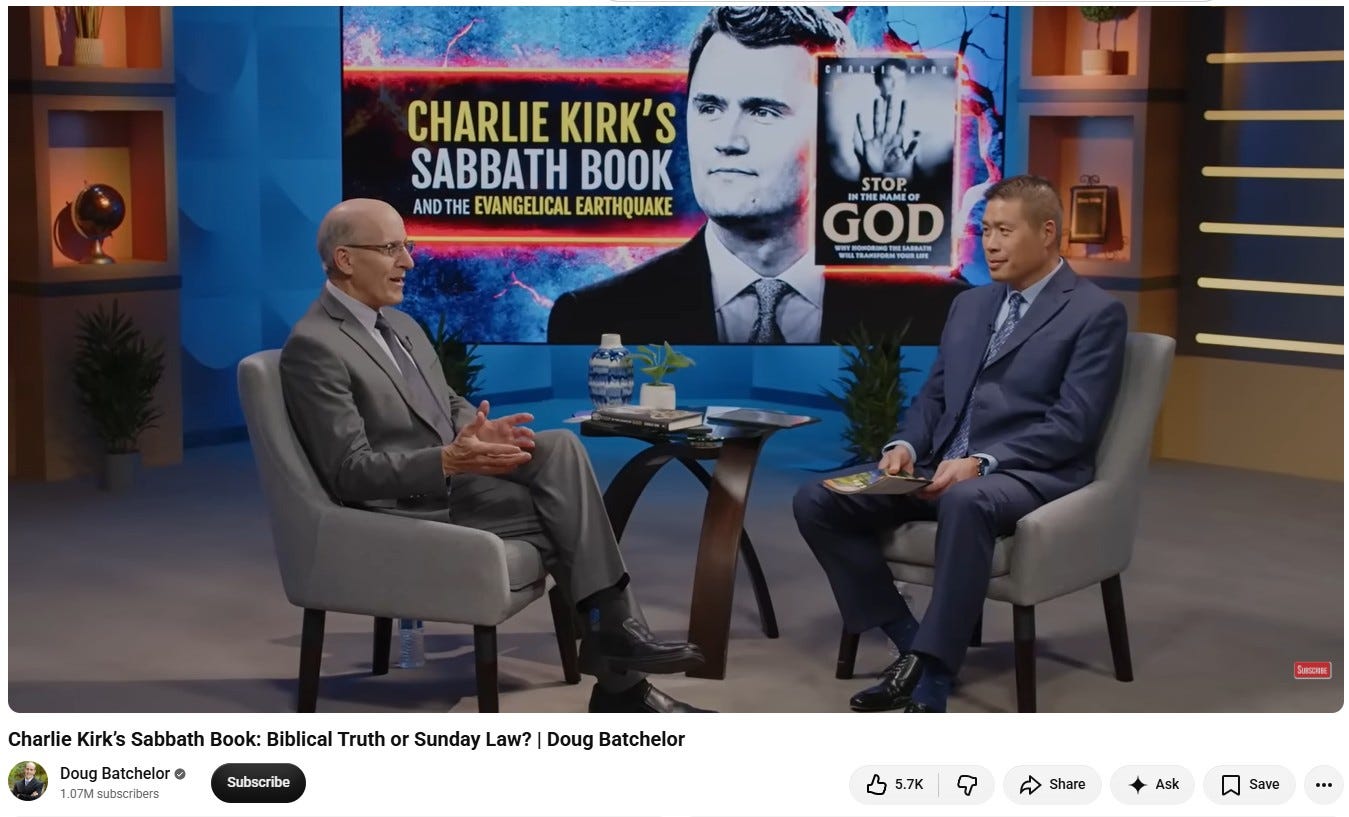
Adventists had sounded the alarms at far less in the past, but now the response from typically fervent traditionalists seemed relatively muted and ambivalent. Doug Batchelor, who heads the Amazing Facts ministry, gave the book his recommendation because it “exalts a biblical principle,” and does so with a depth and quality that impressed him. In a very gentle and diplomatic manner, Batchelor “respectfully” wished that Kirk “had gone a little further” in recommending that all Christians observe Sabbath on the right day—“the Sabbath” not just “a Sabbath.”
The televangelist briefly touched on the book’s passage about “national revival” with some implied discomfort. Yet it seemed that his overriding concern was to portray Kirk as a man who boldly spoke truth, no matter how unpopular, and should be lauded for moving in the right direction on the Sabbath question. Batchelor repeatedly stated that “Charlie personally affirmed the seventh day.” He agreed with a questioner in speculating that editors might have modified and softened advocacy for the seventh day in the manuscript after Kirk’s death. To Batchelor, it “almost seemed that the devil cut him down before he could take it to the next step,” that is, before Kirk could move forward in a journey to full-fledged acceptance of Seventh-day Adventism.
Apocalyptic eschatology along the familiar lines lost none of its force in driving the work of Adventism’s leading evangelists. Yet somehow the historically strong link connecting Adventist evangelistic fervor with endeavor for the nation’s liberal constitutional principles as the best framework for thriving, had been deeply compromised and was now tenuous at best. It was giving way to a new alliance with the antiliberal populism seen on the MAGA side of the culture war. Racial entitlements and LGBTQ accommodations imposed by a progressive state in the thrall of Marxist critical theory overshadowed Christian nationalism as a “clear and present danger.” The antiliberal Adventists continued to speak of religious coercion from a church-state union as a danger on the horizon. Yet they seemed unalarmed by the fusion of chauvinistic nationalism and evangelical culture that, before their eyes, was collapsing the separation of church and state.
Read the full discussion and find documentation of sources in the second edition of Adventism & the American Republic.
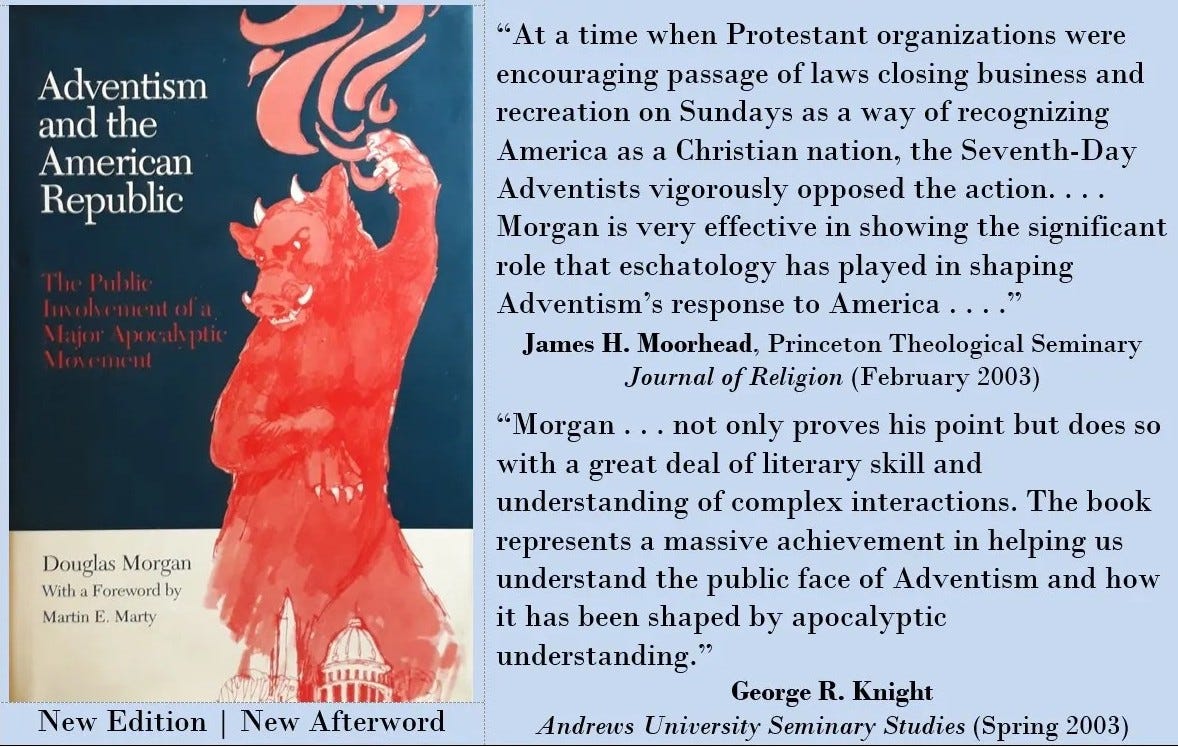
Order now: UT Press | Amazon | Barnes & Noble
Joshua V. Himes, leading publisher and promoter of the Second Advent movement, attributed the movement’s disappointment(s) when Christ did not return to earth on expected dates, to reliance on fallible historians.
For the past couple of months I’ve been setting dates for the release of the new edition, and the elapse of time has proven the source fallible! But like the early Adventists, I have learned to stop setting dates and simply say “soon, and very soon.” See the University of Tennessee Press web page on the book and the booksellers linked there for further details.
Thank you for this, Doug! I look forward to reading the updated edition (whenever that "soon and very soon" might happen).
The million dollar question: how do you explain the seeming "about-face" from these traditionalists when it comes to the way they relate to those who are pushing rhetoric and policies that these traditionalists themselves warned about for decades? It's the great mystery of mysteries!
Without ascribing motives or impugning character, might all this simply be the case of a latent racism/sexism/xenophobia that had been present all along - which has overridden those apocalyptic convictions when seriously challenged?